The Presa Canario
The breed, as it should be
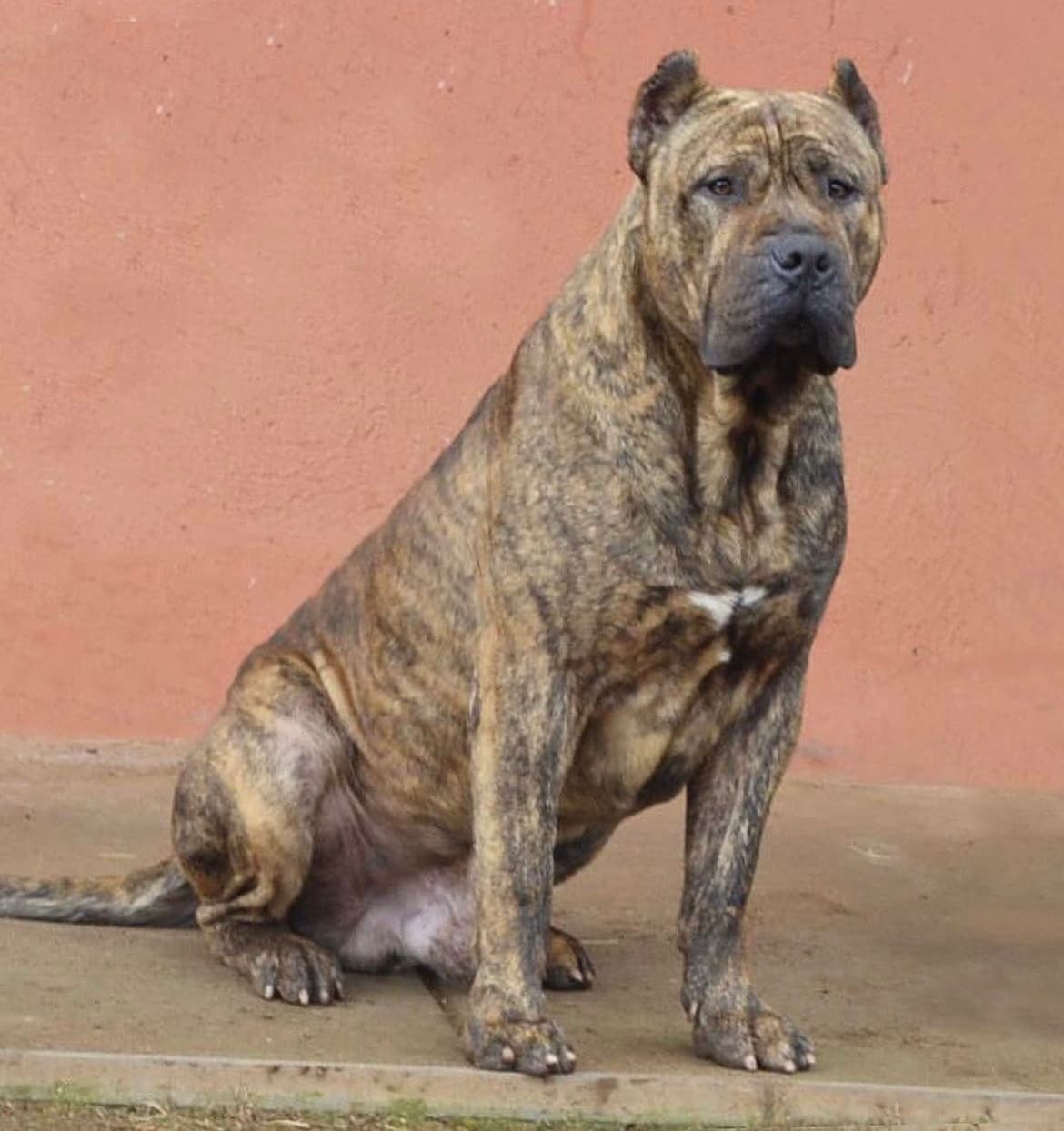
Rustic, strong, steady. The Presa Canario is not a fashion dog. It is the dog of the land, shaped in the Canarian countryside over centuries. This is the one we breed, the one we document, the one we defend.
The true origin
Neither Guanche nor English. Spanish, and of the islands.
The Presa Canario arrived with the conquerors and settlers from 1402 — brave mastiffs and presa dogs newly brought from Spain, in the words of the period. The Tenerife council agreements of 1515 and 1516 already name them, distinguishing the presa dog from the shepherd dog.
The dogs of the Canarian natives were small — “they look like wolves, though they are small”, says Le Canarien. They are not the ancestors of the Presa. And the English did not bring them: in 1873 they imported the presa Toro from Spain (41 kg, 56 cm, bardino coat) in order to rebuild their own Bulldog. The exchange ran the other way.
What we now call the modern Presa Canario was born in the 1970s, from a new selection — not from a “recovery” of something that already existed as it is. The idea of the breed, the name and the first draft of the standard are the work of Manuel Curtó.
“The presa dogs, the cattle dogs and the podencos, just like the pointing dogs and the mastiffs, were brought to the Canary Islands by the conquerors from Spain.”
— Manuel Curtó Gracia · El Perro de Presa Canario, su verdadero origen
The working dog
Forged in the field, not in the ring
Before there were clubs or standards, the Presa did its job on the estates and in the slaughterhouses. The butchers' dogs had to hold cattle. The farm dogs had to protect the place.
The pechadas — traditional dog fights that existed in the Canary Islands until the middle of the twentieth century — were not a show. They were a brutal form of functional selection. Only the dogs with real courage lasted. And that courage is not aggression:
“Do not confuse aggression with courage. Aggression is a synonym for pathology. Courage and temperament are synonyms for bravery, for nerve.”
— Manuel Curtó Gracia
The presas that survived the Canarian countryside and the slaughterhouses were quiet, sure of themselves, not given to biting out of habit, and implacable when they had to be. That character — not the character of the show ring — is what Irema Curtó has preserved for fifty years.
Character
Temperament before anything else
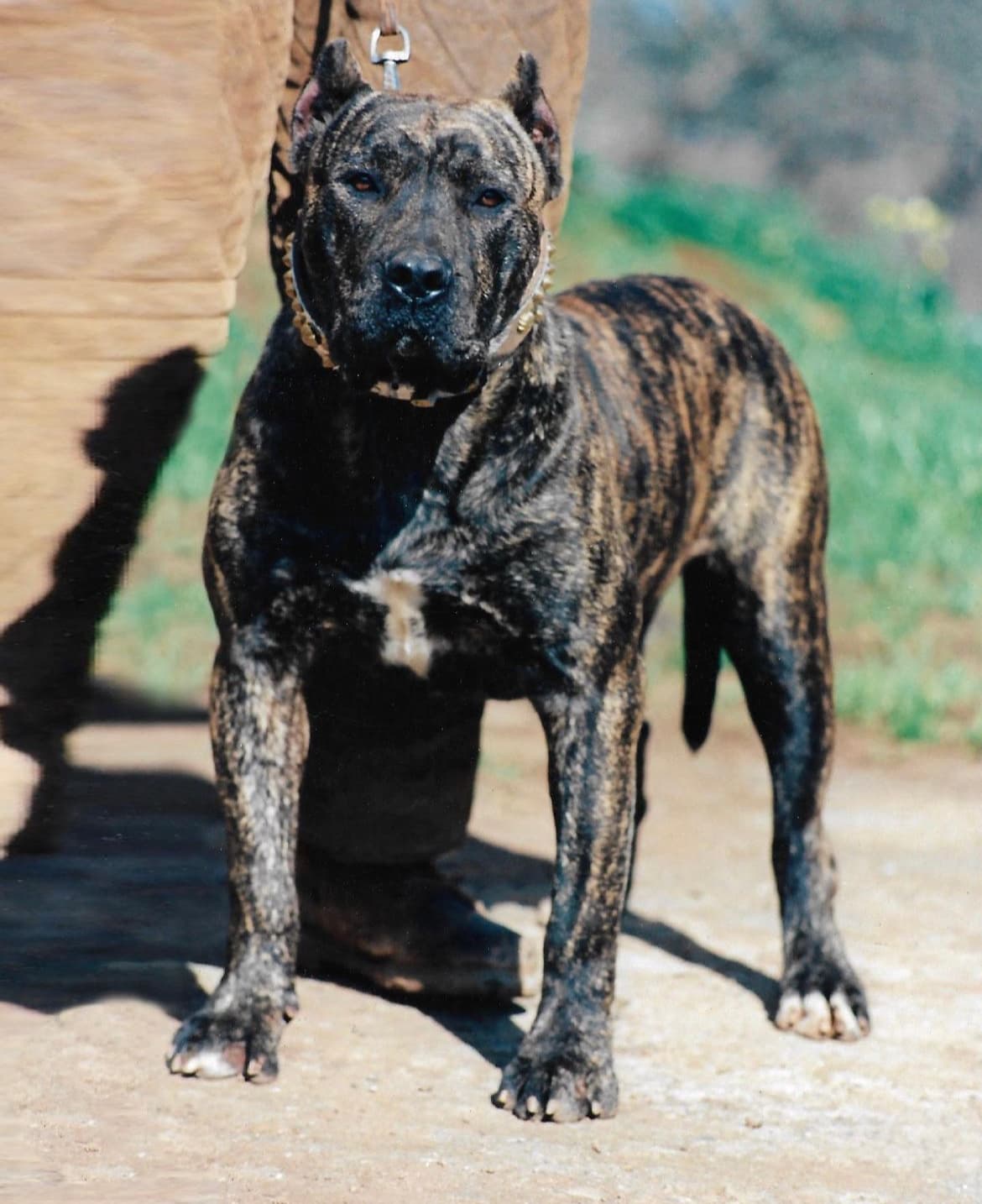
The authentic presa of the land was more serious, less fond of games, and far more reserved with strangers than most breeds. He did not bite without a reason. His presence alone was more than enough.
Steady
A serious animal, almost thoughtful, not much given to play, with a look that is nearly human. He barks little — and when he does, the sound is cavernous and low. Not the yapping of a terrier or a pit bull: the Presa speaks with authority.
Self-possessed
Sure of himself, hard to bribe. He does not flinch at a stick or a threat. His presence, and his growl, are enough to make someone think again. He does not need to bite in order to impose himself.
Balanced
He does not bite without a clear reason. He can put up with children's mischief. Manageable for someone who knows how, firm where he has to be. There is no presa dog without temperament.
“The dog like a blanket. Let an animal come, a predator or a human predator, and let that dog say: ‘I am here.’”
— Manuel Curtó Gracia
The colours of the breed
Bardino, fawn and black
The coats of the authentic Presa have a name and an origin. There is no fashion here. There is documented history, and selection, generation after generation.
Bardino
An old Castilian word, from the Arabic baraxa. A brindle mix of black and fawn hair that recalls a tiger. Also called barcino or lagarte on some of the islands. The most authentic coat of the dog of the land — that is what people in the countryside called it, long before any club existed.
Fawn
Across the whole range, from pale tan to dark copper, with or without a black mask. One of the historic coats of the Canarian presa, already recorded in the council agreements.
Black
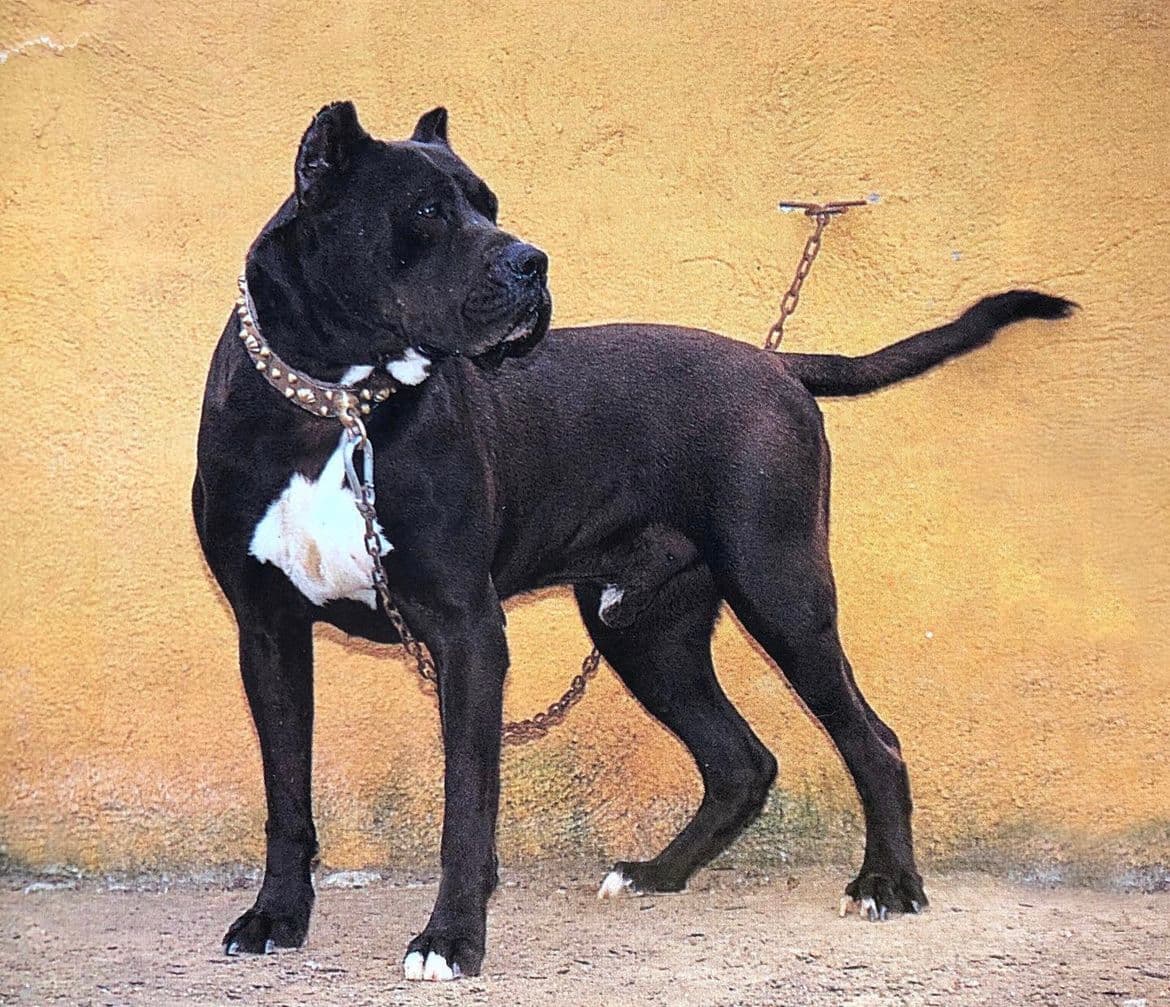
Jet black is part of the history of the Presa. There is documentation of black presa dogs from the days of the pechadas, and Viera y Clavijo mentions black. In the same litters that produce bardinos, blacks are born: to reject one is to reject the other. Irema Curtó has kept a black line for decades, with a waiting list.
A note on the word: the coat is called bardino — not “verdino”. Bardino is an old Castilian word (from the Arabic baraxa), recorded by Corominas and Pascual, and it is what people in the countryside always called it. “Verdino” is a local term from La Laguna with no tradition in dogs.
The standard
The build of a presa
Powerful, broad, medium in height, with a slightly rising topline. Strong without being heavy, agile despite his bulk. The standard was formalised in 1989 from Manuel Curtó's draft.
The ideal presa
In a personal letter of January 2001, Manuel Curtó described his ideal:
“Medium size (62–64 cm, 50–55 kg), slightly higher at the croup than at the withers. Broad skull and muzzle, well developed masseters, a mouth without prognathism. Dark, large eyes. Broad neck, broad chest, ample ribcage. Free of dysplasia. Good character, strong temperament, a marked guarding instinct. And a dark bardino coat, or black.”
— Manuel Curtó Gracia · El Perro de Presa Canario, su verdadero origen, p. 365On prognathism: “The greater the prognathism, the worse the grip.” The undershot mouth — a lower jaw that sticks out — arrived with English Bulldog crosses, and Curtó fought it all his life.
- Height (males)
- 59–64 cm
- Height (females)
- 55–59 cm
- Weight (male)
- 42–55 kg
- Length
- 10–12% greater than the height
- Head
- Brachycephalic, skull to muzzle 6:4
- Bite
- Scissor or pincer, complete
- Tail
- Long to the hock, in a scimitar curve
- Coat
- Short, without undercoat
The secret of the line
The three crosses with the Majorero
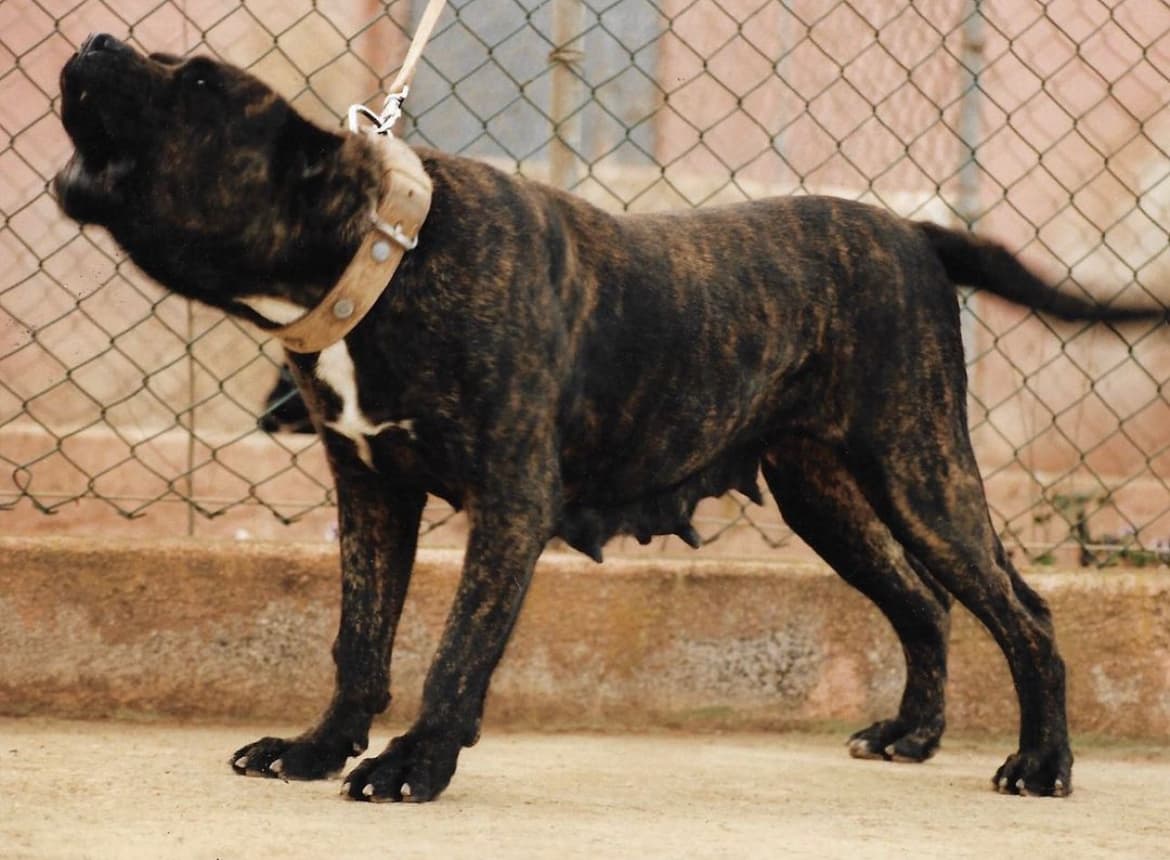
Between the late 1970s and the mid-1980s, Irema Curtó made three founding crosses with the Perro de Ganado Majorero — the descendant of the Spanish mastiffs that survived on Fuerteventura. Those crosses are what separates the Irema Curtó line from the rest.
- Rocky (of Felipe Reyes, Puerto de la Cruz) — radiographed at seven years old, with neither arthritis nor dysplasia. Crossed with two bitches.
- Major I (of Ramón Sosa Roger, Gran Tarajal, Fuerteventura) — a grey male of extraordinary character. Bought at six weeks. “No Majorero cattle dog with the courage of this grey dog has passed through my hands.”
- Arico(males from Lanzarote) — “the purest I have found”. They castrated him days after he covered Curtó's bitch. “What could have been done with that dog…”
The direct result of those crosses: longevity of 14 to 16 years, complete mouths, clean hips and a firm guarding instinct without training. What the other lines do not have, because they never had the Majorero.
“A plain Perro de Ganado Majorero will thrash one of today's crosses, coming and going.”
— Manuel Curtó Gracia
What he is for
A dog made for work
The Presa Canario is a working dog, and as long as he is useful to people his future is secure. Otherwise, as has happened to other breeds, he will end up reduced to an appearance with nothing behind it.
Guard and defence
Guardian of houses, estates and people. A 50–55 kg Presa planted on a property does the job without needing to bark: anyone who sees him thinks twice.
Handling cattle
The catch dog of the Canarian farmer. He controlled cattle heavier than himself. The Tenerife council agreements of 1516 already allowed butchers to keep two presa dogs to hold the stock.
Grip
A dog of the tooth: he goes in, he holds, he does not let go. On big game he is the last to reach the boar and the one who holds it where the others will not. He is a catch dog, not a trailing dog.
Our position
Dog shows are the death of the useful dog
Manuel Curtó said it all his life, and he did not regret saying it. Dogs bred for the show ring are selected for appearance, not for hips, not for character, not for the mouth.
At Irema Curtó we do not go to shows. We never have. And the most sold dogs in the world, with a two-year waiting list and clients in more than 20 countries, are ours.
“My dogs are the ones that sell the most, without any argument, and I do not go to shows.”
— Manuel Curtó Gracia
Far more people want a functional Presa than want a ring Presa. That is our market, and it always has been.
How we breed
Health and truth, before applause
We breed on 17,000 m² of Tenerife hillside. Without hurry. Since 1976 we have fed raw fresh chicken carcasses — never cooked — as the base of the diet. Raw bone is chewed and digested without trouble; cooked bone splinters and punctures. Fifty years of breeding without a single health problem we can attribute to the food confirm it.
We learned it from nature: the first thing eaten from a kill is the intestines, with the half-digested plants, then the flat bones for the red blood cells. The dog is a carnivore built for raw bone, not for kibble.
Health testing
Hip and elbow radiographs, and a DNA test, before any dog is used for breeding. Irema Curtó has never bred from a dog that was not checked.
A complete mouth
No exceptions: no dog with missing premolars, prognathism or an incorrect bite enters the breeding plan. What does not fit the type does not breed.
Temperament, checked
Build is not enough. Guarding instinct, response to training, balance: judged dog by dog, litter by litter. Only the best of each generation.
“Piano piano se va più lontano. Without hurry, but without stopping. I am never in a rush, but I never stop.”
— Manuel Curtó Gracia
“To create is to select. To select is to use what stands out and to set aside what does not measure up.”
Manuel Curtó Gracia · The true origin of the Presa Canario
Meet our dogs
Look at the dogs of Irema Curtó, their pedigrees and their bloodlines. Every dog, with its history.